THE CHARGING NETWORK
One current, every corridor.
India's charging gap isn't a single-city problem — it's a highway network, a patchwork of state electricity boards, and a metro-to-hinterland gap spanning one of the largest road networks on earth. That's the scale XeZap is building into from day one, out from our Kolkata headquarters and along the national highways that already fan out from it.
Pixel map built from a real country outline and city coordinates — India rasterized into a grid, not hand-drawn. Corridors are schematic, not literal GPS routes. Notice how many routes run through Kolkata: that's deliberate, not decorative — it's where XeZap is headquartered, and the rollout fans out along the highways that already meet here, reaching west (Ahmedabad, Surat, Pune), north (Amritsar, Chandigarh, Delhi), central (Indore, Bhopal, Nagpur, Hyderabad) and south (Coimbatore, Kochi) in the phases that follow.
HOW WE PICK A LOCATION
Every site is scored before it's built.
A charger in the wrong spot sits idle. Before XeZap installs a station — or approves a franchise application — the site goes through the same checklist.
Traffic density
Daily vehicle volume on the road or highway segment the site sits on.
Dwell time
How long people naturally stop there — a meal, a shop, an overnight stay — long enough to charge without it feeling like a delay.
Grid capacity
Whether the site's electrical connection can support fast charging today, or with a feasible upgrade.
Corridor priority
Whether the site fills a gap on a route already marked out in the current rollout phase.
ROLLOUT ROADMAP
How the network gets built.
Founding phase — metro corridors
Owned and franchise stations go live in dense Indian metro corridors, alongside the first release of the driver app and the host dashboard. This is where XeZap is today.
Highway backbone
XeZap Highway and Apex chargers along the Golden Quadrilateral and major freight corridors radiating out from those metros — fuel outlets, dhabas and parking operators onboarded as franchise hosts along the route.
State-capital & tier-2 saturation
Every state capital and the industrial towns that sit off the main national highways — places most networks treat as "later" — brought onto the network alongside the metros, not years behind them.
Full network parity
One app, one payment method and one support line, whether a driver is charging in Mumbai, Guwahati, or a highway dhaba outside Nagpur.
WHY INDIA, WHY NOW
The biggest EV market nobody's finished building for.
India's public charger-to-EV ratio sits at roughly 1:235 against a global average nearer 1:12 — and industry data suggests close to half of the chargers that do exist go non-functional at some point. That's not a market waiting to happen; it's a market already running ahead of the infrastructure meant to support it, on a country-sized scale no single-city network can meaningfully close.
India isn't one electricity market — it's 28 states and 8 union territories, each with its own DISCOM, tariff structure and connection process. That complexity is exactly why September 2024's Ministry of Power guidelines de-licensed setting up a charging station and put DISCOMs on a firm connection-time SLA: the rulebook got out of the way nationally, but the operational complexity of dealing with each state individually didn't disappear — it just became something a network has to be built to absorb, not something a driver or a host should ever have to think about.
That's the reasoning behind treating the whole country as one build from day one rather than expanding city by city: a franchise host in a highway town in Odisha and a driver in South Mumbai should get the identical app, the identical payment rail and the identical support line, regardless of which state's grid is behind the socket. It's also why the map above is only part of the plan — the Off-Grid Solar Skid lets the network reach villages and remote sites that don't have a viable grid connection at all, not just the corridors where DISCOM infrastructure already exists.
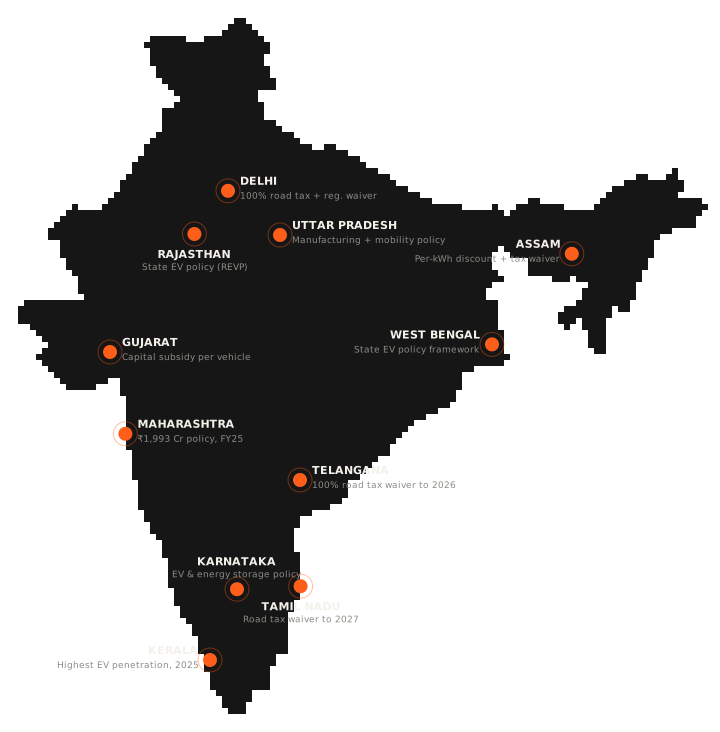
Eleven states shown here have a confirmed, active dedicated EV policy as of 2025 — this isn't every state working on one, just the ones independently verifiable at time of writing. The point isn't the exact count; it's that "state policy" is 28+ separate moving targets, which is precisely the complexity XeZap's platform is built to absorb centrally. See the full state-by-state breakdown for what each policy actually offers.
NETWORK FAQ
What people usually ask.
When will a station be near me?
Depends which phase covers your route — check the roadmap above, or join the waitlist on the home page for updates specific to your city.
Does the app work the same in every state?
Yes — one account, one app, with local language and payment support baked in, regardless of which state's electricity board sits behind a given station.
Are owned and franchise stations different quality?
No — every station runs the same certified hardware and connects to the same monitoring platform, regardless of who owns the site.
Can my highway property be part of a future phase?
Apply through the franchise program — our site-assessment team will tell you which phase it realistically fits.
BUILD IT WITH US
Own land on a corridor we're planning for?
Whether you're on a national highway, a state-capital route, or a dense city corridor — tell us where, and we'll tell you where it fits in the rollout.