CHARGING HARDWARE
Chargers built for two-wheelers to fleets.
Every XeZap charger — whether it's bolted to an apartment wall or standing on a highway forecourt — speaks the same protocol, reports to the same platform, and gets the same remote monitoring. At the top of the range sits Apex, our flagship DC fast charger engineered to lead the region on raw charging speed. This is the line-up we're bringing to market through 2026–27.
AC CHARGING
Slow & steady, where vehicles already park.
Homes, apartments, workplaces, hotels and malls — anywhere a vehicle sits for hours. AC chargers are quieter, cheaper to install, and designed to run untouched for years. One connector per unit — a single vehicle, charged steadily, for as long as it's parked.
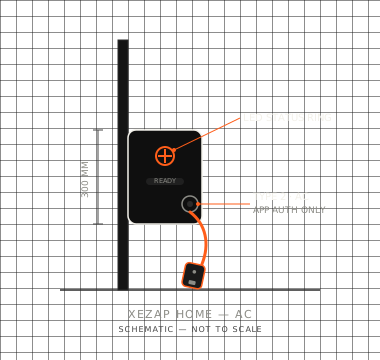
XeZap Home
A smart wall-box for private homes and individual apartment bays.
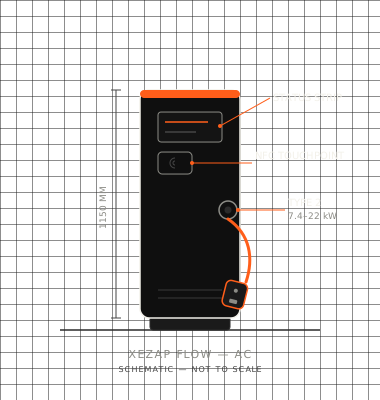
XeZap Flow
Commercial-grade AC for workplaces, hotels, malls and housing societies with multiple bays.
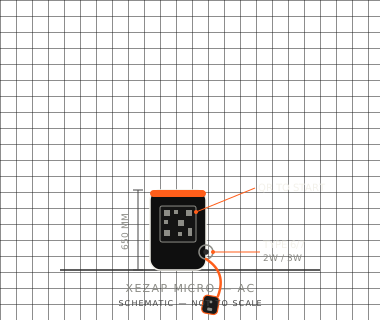
XeZap Micro
Compact charger for two- and three-wheelers — the highest-volume EV segment on Indian roads.
Which AC charger fits your site?
DC FAST CHARGING
Rapid charging for highways & fleets — up to 480 kW.
Built for vehicles that can't afford to sit still — cabs, buses, delivery fleets and highway travellers who need to be back on the road in minutes. Most public DC networks in India today top out somewhere between 120 kW and 360 kW. XeZap's flagship Apex line is engineered to clear that ceiling entirely.
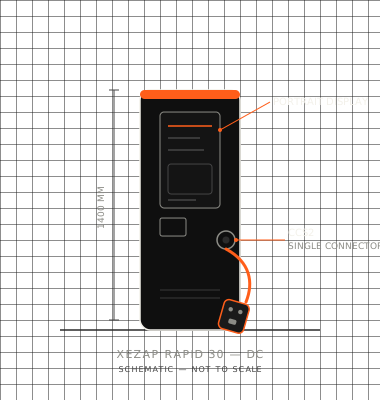
XeZap Rapid 30
Compact DC unit for city hubs, cab aggregator lots and small forecourts.
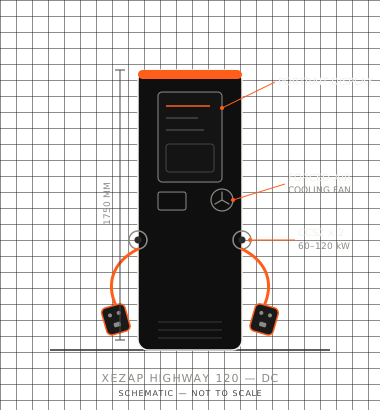
XeZap Highway 120
The standard for highway forecourts and franchise sites — dual-gun, high duty cycle.
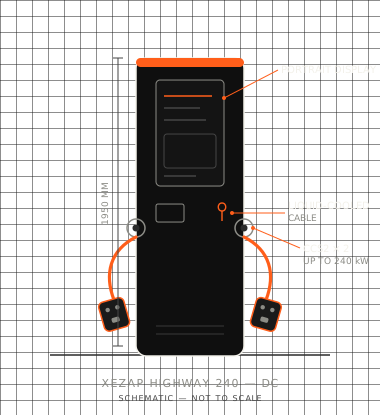
XeZap Highway 240
Premium highway hub charger for high-traffic corridors and busy franchise forecourts.
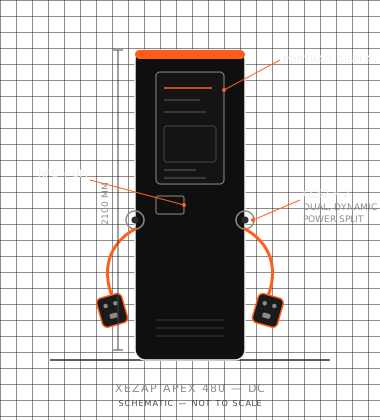
XeZap Apex 480
Our industry-leading ultra-fast charger — sized for flagship highway hubs, bus corridors and fleet depots.
WHY 480 kW
Built to lead, not just to compete.
A charger's headline number only means something if the vehicle and the cable can actually use it. Apex is designed around that reality: a liquid-cooled cable keeps the conductor thin enough to hold with one hand even at peak current, and dynamic power sharing splits the full 480 kW across both guns in real time — so a bus on one side and a car on the other both charge at the fastest rate the site's grid connection allows, not a fixed 50/50 split.
For a highway hub, a bus depot, or a flagship city-anchor station, that's the difference between a charger that's technically fast and one that actually clears queues at peak hours.
ENGINEERING UNDER THE HOOD
What makes a 480 kW claim credible.
Anyone can print a number on a spec sheet. Delivering it reliably, at scale, across two climates as different as the Gangetic plains and the Himalayan foothills, is the actual engineering problem.
Liquid-cooled cables
Above 120 kW, an air-cooled cable gets too thick and heavy to hold comfortably. Our 240 kW and 480 kW chargers circulate coolant through the cable itself, keeping it slim at peak current.
Dynamic power sharing
Dual-gun units allocate power in real time based on what each connected vehicle can actually accept, instead of a fixed split — so one slower vehicle never throttles a faster one.
Built for extreme climates
Rated from −20°C to 55°C, so the same hardware standard holds on a Rajasthan highway at midday and a Himalayan pass in Ladakh in winter.
Modular, repairable design
Power modules, screens and payment readers are field-replaceable units — a fault gets swapped out on site in minutes instead of taking the whole charger offline for days.
OCPP 2.0.1 & ISO 15118-ready
Open protocol from day one, with the roadmap built for Plug & Charge — authenticate and pay automatically the moment the connector locks in, no app required.
Predictive diagnostics
Every unit reports health telemetry continuously, so our ops team can often flag a failing part before a driver ever sees an error on the screen.
ONE PLATFORM
Every charger reports to the same network.
Hardware is only half the job. Every XeZap unit — owned or franchised — connects into one management layer, so a host or a driver never has to think about who installed it.
OCPP compliant
Open protocol, so future hardware and third-party operators can plug into the same network without a rebuild.
Remote monitoring
Uptime, faults and session data visible from the host dashboard and the XeZap ops centre in real time.
App, NFC & UPI
Drivers start a session however suits them — the app, an NFC tap, or a UPI QR code at the charger.
24/7 support
A single support line for drivers and hosts alike, backed by remote diagnostics before a truck roll is ever needed.
Dynamic load management
Reads a site's real available power and shares it safely across every connected bay, so hosts never need to over-build their electrical connection.
Every state, one app
App, receipts and support in English, Hindi and regional languages, with UPI built in as the default payment rail — one platform, every state.
Secure by design
TLS-encrypted communication between charger and cloud, role-based access on host dashboards, and regular firmware security updates pushed remotely.
Over-the-air updates
New features and fixes ship to every charger on the network remotely — no technician visit required for a software release.
CHOOSING A CHARGER
Match the site to the tier.
FULL SPEC SHEET
Every charger, side by side.
For procurement teams and installers who want the raw comparison rather than reading seven separate cards — every AC and DC unit's specs in one table. Scroll right on smaller screens.
| Spec | Home | Flow | Micro | Rapid 30 | Highway 120 | Highway 240 | Apex 480 |
|---|---|---|---|---|---|---|---|
| Power | 3.3 / 7.4 kW | 7.4 – 22 kW | 1.5 – 3.3 kW | 30 kW | 60 – 120 kW | Up to 240 kW | Up to 480 kW |
| Input | Single-phase, 230V | Single or 3-phase, 415V | Single-phase, 230V | — | — | — | — |
| Connector | Type 2 AC | Type 2 AC | Type 6 / 7 | CCS2 | CCS2 (dual) | CCS2 (dual) | CCS2 (dual, dynamic split) |
| Cooling | — | — | — | Natural convection | Forced-air | Liquid-cooled cable | Liquid-cooled cable |
| Protection | IP55, RCD Type A/B | IP55, RCD Type A/B | IP54 | — | — | — | — |
| Vehicles | — | — | — | Cars, cabs | Cars, light commercial | Cars, light commercial | Cars, buses, fleets |
| Auth | App | App / NFC | App / QR | App / NFC / UPI | App / NFC / UPI | App / NFC / UPI | App / NFC / UPI |
| Mounting | Wall | Wall or pedestal | Pedestal | — | — | — | — |
CERTIFICATION & TESTING ROADMAP
Compliant by design, not retrofitted for an inspector.
India's EV charger certification requirements aren't optional paperwork — they're baseline safety and interoperability standards, and BIS compliance has been mandatory for chargers sold in India since 2024. Here's where each requirement sits on our roadmap, stated honestly rather than implied as already done.
BIS IS 17017
The mandatory Indian standard covering AC/DC charger safety, connectors and communication, aligned with global IEC 61851/62196 norms. Required type-testing at a BIS-recognized lab is on our pre-manufacturing checklist for every SKU.
ARAI approval
Higher-power DC units (Highway 120 and above) require ARAI type approval alongside BIS certification — part of the certified-manufacturing milestone ahead of the Highway and Apex line's roadmap release.
CEA grid compliance
Voltage limits, harmonics filtering and grid-connectivity rules set by the Central Electricity Authority — designed into the power electronics from the start, not patched in after a DISCOM rejects an installation.
Environmental & IP ratings
IP54/IP55/IP65 ingress protection per unit (see the spec table above) and the −20°C to 55°C thermal range are tested at the enclosure and component level, not just claimed on a spec sheet.
XeZap is pre-launch — "IN DEVELOPMENT" and "ROADMAP" tiers above have not yet completed formal certification. No unit ships to a customer or franchise site before its required certifications are in hand.
BEYOND THE GRID
The charger for wherever the grid doesn't reach yet.
Every charger on this page assumes a grid connection is either already there or worth waiting for. For a huge share of rural and remote India, neither is true — a new DISCOM connection can take months to arrive, if it's economical to run at all, and diesel gensets remain the default backup. That's the gap the XeZap Off-Grid Solar Skid is built for: a solar array, a battery buffer and a hybrid inverter, pre-sized to feed a standard XeZap Micro, Home or Rapid 30 charger with zero grid dependency — and an optional genset or grid-tie input for the days the sun doesn't cooperate.
This isn't a separate charging standard — it's a power source that sits behind any of our AC or DC units, so a village charging point runs the exact same app, tariff and support experience as a station in Mumbai. It's aimed squarely at the individual plot owner in a highway village, a farmer already running solar under schemes like PM-KUSUM, or a panchayat looking to bring EV charging to a market square without an electrical upgrade. See how it actually works for the full breakdown.
IN DEVELOPMENT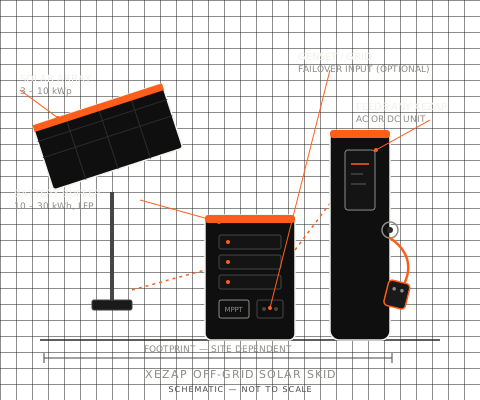
No grid connection required
A 3–10 kWp solar array and a 10–30 kWh LFP battery buffer are sized to run a Micro or Rapid 30 charger through the day and into the evening, entirely off-grid.
Genset or grid failover, optional
A failover input accepts a diesel genset or a weak/unreliable grid line as backup — displacing diesel as the primary source, not requiring it.
Same app, same network
The skid is a power source, not a different product line — sessions, billing and monitoring run through the identical XeZap platform as every grid-connected station.
Built for panchayats & plot owners
No electrical contractor, no DISCOM application, no waiting on a connection SLA — the single biggest barrier for a rural or highway-village host disappears.
TALK TO US
Fleet, bulk or franchise pricing?
If you're planning a deployment — a fleet depot, a housing society, or a chain of highway outlets — tell us the scale and we'll get back with the right configuration.