TECHNOLOGY
The stack the next generation charges on.
Anyone can bolt a charger to a wall. The harder problem — the one most of India's public network hasn't solved yet — is keeping it working, matched to whatever vehicle plugs in, and unaffected by a grid that isn't always stable. That's the layer XeZap is actually building.
THE REAL PROBLEM
India doesn't just need more chargers. It needs chargers that stay working.
Industry-wide data on India's public charging network has shown close to half of all installed chargers going non-functional at some point, and roughly a quarter facing frequent downtime — from grid instability, delayed maintenance, or faults nobody caught in time. A driver doesn't care how many chargers exist on a map if the nearest working one is 40km away.
XeZap is built around that number, not around it. Every feature on this page exists to keep a charger in the "working" column — not to add another chip to a spec sheet.
VEHICLE INTELLIGENCE
Every charger knows what's plugged into it.
The moment a connector locks in, XeZap identifies the vehicle — by app profile, an NFC tap, or the handshake the vehicle itself sends — and pulls its exact charging profile before a single kWh moves.
Automatic vehicle recognition
Connector type, battery chemistry and onboard charger limits are read the instant a session starts — no manual selection needed from the driver.
Adaptive charging curve
Power is delivered to the exact curve that vehicle's battery accepts safely — not a generic ramp that either undercharges or stresses the pack.
Safety limits, enforced automatically
Voltage, current and temperature ceilings are set per vehicle, not per charger — so the same bay is safe for a two-wheeler and a bus.
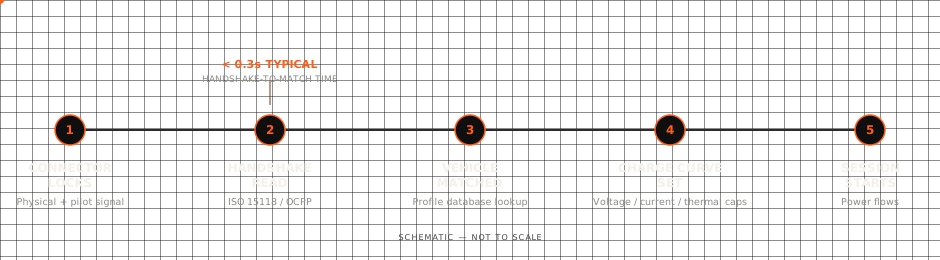
None of this is a single black-box "AI decision" — it's a defined handshake sequence. The moment the connector's pilot signal confirms a physical lock, the charger reads the vehicle's ISO 15118 or OCPP handshake (whichever the vehicle sends), matches it against the onboard profile database, and pulls the exact voltage, current and thermal ceilings that vehicle's battery management system has already told the industry it can accept. Typical time from lock to a matched, applied charging curve is under 0.3 seconds — a driver never experiences it as a "step," just as the charger starting immediately.
ONE DATABASE, EVERY EV
Built against a growing library of every make and model on the road.
Two-wheelers, three-wheelers, cars, buses and fleet vehicles across India don't share a single charging spec. XeZap maintains a continuously updated database of vehicle charging parameters — connector standard, max acceptance rate, battery chemistry, thermal limits — so a charger adapts to the vehicle instead of the other way around.
GRID-AWARE CHARGING
Built for a grid that isn't always steady.
Voltage fluctuation, brownouts and uneven supply are a daily reality on large parts of the Indian grid — not an edge case. XeZap's load management layer is designed around that reality, not in spite of it.
Automated load balancing
Power is shared dynamically across every bay on a site in real time, based on what's actually available from the grid connection at that moment — not a fixed split.
Instability protection
When incoming power dips or spikes, the charger throttles or briefly holds the session rather than dropping it outright or passing instability through to the vehicle.
In-app visibility
If a session is affected by grid conditions, the driver sees it in the app in plain language — not silence, and not a blank error code.
Off-grid, when there's no grid at all
For sites with no viable grid connection, the same load-management logic runs against a solar array and battery buffer instead — the Off-Grid Solar Skid, not a separate app or a separate standard.
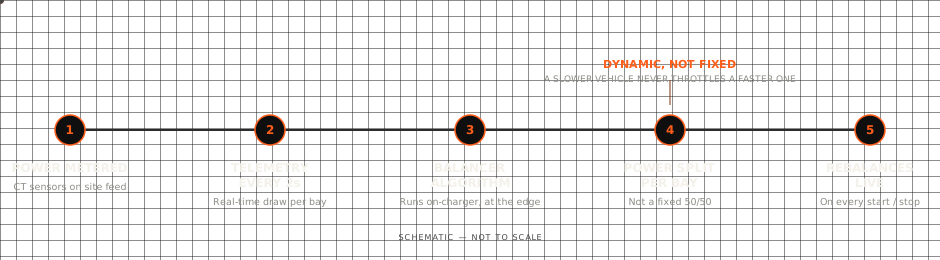
The balancing decision runs on the charger itself, not in a distant cloud data centre — a round trip to a server and back is too slow to react to a real-time draw spike. Current-transformer sensors on the site's incoming supply feed live telemetry roughly every two seconds; when a second or third bay starts a session, the on-charger algorithm re-splits available power immediately rather than the first vehicle simply keeping whatever it grabbed first. That's also the same logic that means one slow-charging two-wheeler on a shared bay never throttles a car parked next to it that could accept more.
PREDICTIVE MAINTENANCE
Fixed before it fails, not after.
Most public chargers in India run a reactive maintenance model: something breaks, then someone gets dispatched to fix it — often days later. XeZap's chargers report continuous health telemetry, so wear gets caught while it's still routine maintenance, not an outage.
Continuous diagnostics
Connector wear, cooling performance and component temperatures are monitored around the clock, not checked on a site visit.
Scheduled servicing
Filters, contactors and cooling components are replaced on a data-driven schedule — before they degrade charging speed or safety margins.
Field-replaceable modules
Power modules, screens and payment readers swap out on site in minutes when something does need physical replacement.
Remote firmware fixes
Most software issues are resolved with an over-the-air update, not a technician visit — cutting the single biggest source of downtime delay.
THE APP
Built around the trip, not just the plug.
Route-based suggestions
Enter a destination and the app plots charging stops along the actual route — factoring your vehicle's range, current charge and real-time station availability, not just nearby pins on a map.
NFC tap & UPI, natively
Start a session with one tap of your phone or an NFC card, or scan a UPI QR code — no fumbling for a physical card. UPI and NFC are built into the network from day one, not bolted on as a workaround.
XeZap Wallet
Top up once via UPI, debit/credit card or netbanking, then every session is deducted automatically — no payment prompt mid-charge. Save more than one card if you want options.
Local by default
English, Hindi and regional languages, with UPI as the default payment rail — one app that feels native whether you're charging in Kolkata or Kochi.
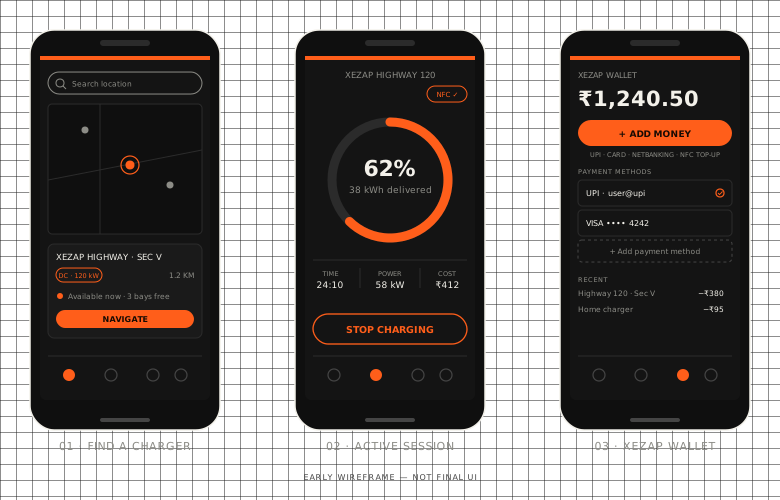
Early wireframe — screens are still in design, not final UI.
CARBON-LINKED REWARDS
Every session earns you something — and the planet something too.
Every kWh delivered through the network converts into two numbers at once: points, and an estimated CO₂ saved figure calculated against the Central Electricity Authority's published grid emission factor (0.71 kg CO₂/kWh, FY 2024-25) versus an equivalent petrol trip for that vehicle segment — a transparent, published methodology, not a marketing black box. Points build toward tier status; CO₂ saved builds toward something to actually be proud of.
Segmented leaderboards
Ranked by city, nationally, by vehicle segment, and among friends — a two-wheeler commuter and a fleet operator are never competing on the same board.
Tiered, real rewards
Free charging kWh, priority queue passes at busy stations, and discounts at the restaurants and hotels hosting XeZap chargers — funded by cheap off-peak power and host footfall, not margin.
A shareable impact card
A monthly recap — kWh charged, CO₂ saved, tier, rank — built to be posted, not just checked. If a driver hits Gigawatt tier, they'll want people to know.
Referral bonus
Bring a friend onto the network and you both get points the moment their first session completes — growth that costs kWh, not ad spend.
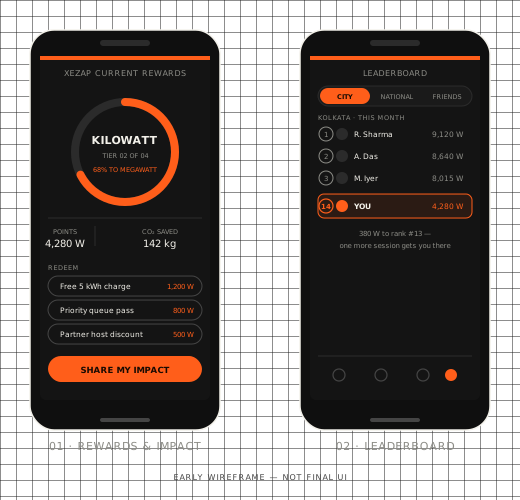
Early wireframe — screens and exact point values are still in design, not final UI.
WHY WE OWN THE WHOLE STACK
Five layers, one team, one loop.
Most charging problems in the field trace back to a gap between vendors: the hardware maker blames the network software, the network software blames the grid, and the driver just sees a broken charger. XeZap designs the charger, writes the firmware, and runs the cloud platform ourselves — every layer below, from copper to touchscreen, is one team's responsibility, not three companies pointing at each other.
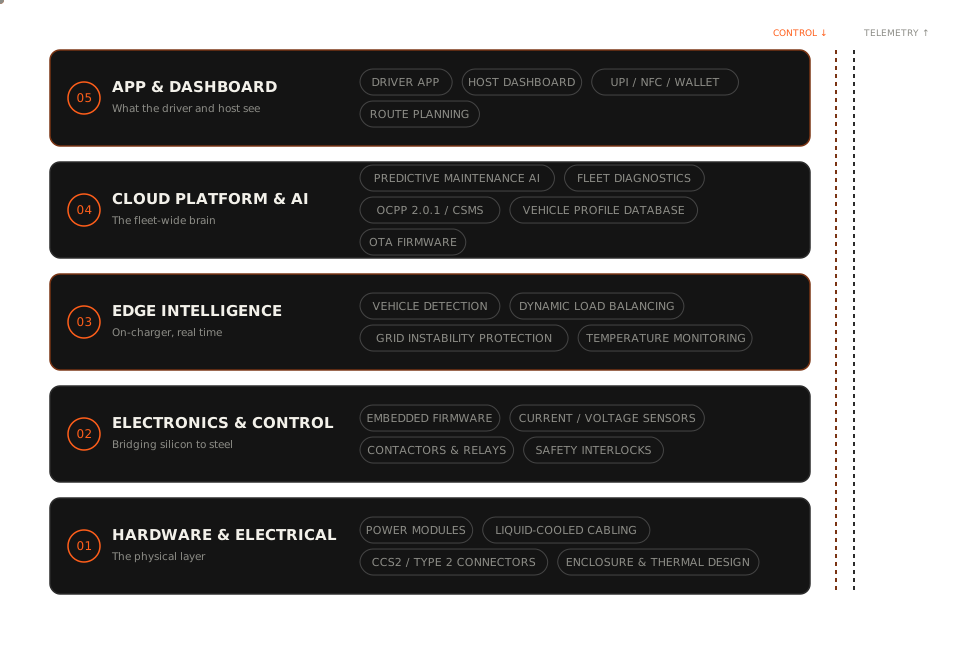
Control commands flow down the stack; telemetry — temperature, load, faults, session data — flows back up, so every layer sees what every other layer is doing.
It also means every lesson from a station in Kolkata improves every other station on the network overnight, through the same firmware and platform update — including the ones we don't own outright.
WHY INDIA, WHY NOW
The market is inflecting. The network hasn't caught up.
Three things are true in India at the same time, and none of them were true even two years ago.
EV adoption is surging
India's public charger count grew roughly eightfold between 2022 and late 2025 — but even at ~39,500 chargers nationwide, fewer than a quarter of those are DC fast chargers. EV sales are growing faster than either number.
The rules just got easier
The Ministry of Power's September 2024 guidelines de-licensed setting up a charging station entirely, and now require DISCOMs to connect new stations within 3 days in metros, 7 in smaller cities, and 15–30 in rural and hilly areas — with penalties for delay.
Reliability is still unsolved
Faster approvals and more capital are flowing in, but the technology layer — the part that keeps a charger working — hasn't kept pace. That gap is precisely where XeZap is built to compete.
Put together: easier rules, surging demand, and a network that's still unreliable at scale. That combination doesn't last long in any market — it's the window a new network standard gets built in, not after.
ON THE HORIZON
Some of this depends on more than engineering.
We'd rather tell you what we're designing toward honestly than pretend it's live. Face-based activation — glance at the charger, plug in, done, the same instinct behind Face ID — is on our roadmap. No phone, no tap, no card.
Biometric data is treated as sensitive under data protection law in every country we operate in, and rightly so. So this ships opt-in only, processed on-device as an encrypted mathematical template rather than a stored photo, with NFC and the app always available as the default — and only once we have a clear, compliant path under each country's rules for biometric processing. Not before.
TECHNOLOGY FAQ
The questions engineers and hosts actually ask.
Is the vehicle-detection AI actually machine learning, or just a lookup table?
Both, honestly. Matching a connected vehicle to its known charging profile is a fast, deterministic database lookup against the ISO 15118/OCPP handshake — no ML needed for that part, and pretending otherwise would just be marketing. The learning happens one layer up: fleet-wide telemetry trains the predictive-maintenance models and refines default charging curves for vehicle profiles that aren't in the database yet.
What happens if a vehicle sends no handshake at all — an older EV, for example?
The charger falls back to a conservative default curve for that connector type and lets the vehicle's own onboard charger govern the ceiling, the same way a standard non-smart charger would. Nothing about a legacy vehicle attempting to plug in fails — it just doesn't get the adaptive optimization a newer vehicle does.
Does dynamic load balancing mean my session could randomly slow down?
Only if another vehicle plugs in on a shared circuit and the site's total available power is genuinely being split — never because of a software decision unrelated to real electrical constraints. The in-app visibility feature exists specifically so a driver sees why, in plain language, if that happens.
Is XeZap building its own OCPP backend, or using a third-party CSMS?
Our cloud platform is OCPP 2.0.1 compliant and built in-house, not a white-labelled third-party CSMS — that's part of why a fix or feature ships to the whole fleet on the same release cycle instead of waiting on an external vendor's roadmap.
How is the CO₂-saved figure in Current Rewards actually calculated?
Against the Central Electricity Authority's published grid emission factor (0.71 kg CO₂/kWh, FY 2024-25) compared to a petrol-equivalent trip for that vehicle segment — the same public number used for carbon-credit accounting in India, not an internal estimate we made up.
What's the actual failure mode if the cloud platform goes down mid-session?
A session already in progress keeps charging — the edge intelligence layer on the charger itself owns real-time control (vehicle matching, load balancing, safety limits), so it doesn't need a live cloud connection to finish a session safely. The cloud layer handles fleet-wide telemetry, billing reconciliation and OTA updates, which can queue and sync once connectivity returns.
SEE IT IN CONTEXT
This is the platform every XeZap charger runs on.
See the hardware it runs on, or talk to us directly about a deployment, a franchise site, or an investment.